Did you ever find your ability to commit to or believe in a cause you think is right, come into question because a person you trusted to represent that cause turns out to not be quite who you thought they were?
The credibility of what you represent depends on your own character and resulting behaviors in every area of your life. People are watching you. All the time. Who you are and what you do, even in private, matters.
We’ve been exploring the book of 1 Timothy. The overarching theme of the book is “Guarding the Mission.” In the first two chapters we looked at how Paul pointed Timothy in the right direction to focus on and guard what mattered most to God and to the church in Ephesus at that time.
The church had lost focus, and was in danger, was drifting. Timothy had the responsibility of steering it back on course, but he needed help, the purpose of the letter.
As we look at Chapter 3, we’re going to see how Paul exhorts Timothy on the importance of the character and behavior of the people in the church, because they are the witnesses of the gospel message to the world.
The emphasis is on the leaders in the church, the elders and deacons, because they are most visible and therefore most susceptible to harming people’s trust in the gospel message. But, I believe Paul’s message applies to each and every Christian in the church.
All of us are witnesses to God’s glorious, merciful, redeeming message of abundant life and eternal salvation, and the degree to which people in this world will find that message credible and compelling is dependent on our character and behavior. We must guard our witness.
Let’s jump in and start reading Chapter 3. The first 7 verses cover …
Character and Behavior of Overseers
1 Timothy 3:1-7 (ESV)
1 The saying is trustworthy: If anyone aspires to the office of overseer, he desires a noble task. 2 Therefore an overseer must be above reproach, the husband of one wife, sober-minded, self-controlled, respectable, hospitable, able to teach, 3 not a drunkard, not violent but gentle, not quarrelsome, not a lover of money. 4 He must manage his own household well, with all dignity keeping his children submissive, 5 for if someone does not know how to manage his own household, how will he care for God’s church? 6 He must not be a recent convert, or he may become puffed up with conceit and fall into the condemnation of the devil. 7 Moreover, he must be well thought of by outsiders, so that he may not fall into disgrace, into a snare of the devil.
What is an “overseer,” anyway? We find the terms overseer, elder, shepherd, and even pastor often used interchangeably throughout the New Testament. In some sense they are all the same thing, though there are subtle differences.
I find one of the most useful references in Acts 20, where Paul addresses in v. 17 the church leaders whom he calls “elders” (Greek word presbyteros (pres-boo’-ter-os)). He goes on to say in v. 28, “Take heed to yourselves and to all the flock, among which the Holy Spirit has made you overseers (Greek word episkopos (ep-is’-kop-os)), to shepherd (Greek word poimainō (poy-mah’-ee-no)) the church of God, which He purchased with His own blood.” So the elders are assigned, through the Holy Spirit, the roles of overseeing and shepherding.
Paraphrasing verse 1, Paul essentially says this job might not be for everyone. Why not? What’s the risk?
What I see here is a description of a person whose faith has had a tangible impact on their character and resulting behaviors. This person is in complete contrast to the religious adversaries of Jesus, and Christianity, described throughout the New Testament, like the pharisees who so annoyed Jesus. In other words, the person described here is the opposite of a hypocrite. They do practice what they preach. Their character does align with their beliefs.
And remember, Paul is emphasizing the importance of these traits for an overseer, but they apply to all of us, because we are all witnesses of the gospel.
How about the list of traits itself? It’s certainly not an easy set of standards to meet, is it? I want to share a little of my personal experience with this list.
I remember reading this list over and over again, along with the complementary list in Titus 1. Somehow I had to resolve in my head how I could become an elder of a church knowing that I did not perfectly meet the standards of this list in every way.
I remember at the time my rather immature way of thinking was to focus on the majority of items on the list I had “in the bag,” so to speak, the ones I was naturally good at. And then I just sort of swept under the rug the ones in which I knew I wasn’t perfect, my weak spots, justifying it with an “I’m-only-human” excuse.
What I’ve learned as I’ve matured in life and my Christian walk (at least a little, I’m still far from where I want to be) is to see this list very differently. For those items that come naturally to me, where there’s no struggle, I try to be grateful for these and then not give them another thought, lest pride creeps in.
Instead, I put my focus on the (hopefully fewer) items with which I DO struggle. These are the ones I know I can’t overcome on my own, the ones for which I need to trust Jesus and rely on the power of the Holy Spirit to convict me, keep short accounts, with repentance, and therefore keep under control.
In verses 3-5 there are 5 positive character traits an overseer should have, 4 negative character traits an overseer should not have, and 3 abilities. The 5 positive traits are:
- Above reproach,
- Sober-minded,
- Self-controlled,
- Respectable,
- Hospitable.
The 4 negative traits are:
- Not a drunkard,
- Not violent (but gentle),
- Not quarrelsome,
- Not a lover of money.
And the 3 abilities are:
- Husband of one wife (literal translation of original Greek: “one woman man”),
- Able to teach,
- Able to manage his own household well.
Verses 4 and 5 are particularly interesting, because Paul suggests there is a close connection and analogy between a household and the church, which he actually calls the “household of God” later in the chapter, in v. 15! That suggests there is an analogy between a man’s role as father in his household and his role as an overseer in the church, which gives us a little more insight into what an overseer is.
A father’s job is not only to protect, provide for, and instruct his children, but also to serve as a model (to the extent it’s humanly possible) of God’s unconditional love for his children, so that when they grow up, they enter adulthood with at least some understanding of what it means to have a father who truly loves them, thus preparing them for a personal relationship with God.
So an overseer’s role is also not only to protect and instruct the church, but also the role involves modeling God’s love and care. Those are certainly sobering words for me.
Yet again, I remind you, these words have application for all of us in our roles as guardians of the witness of the gospel message. We are all called to model God’s love in this world, as difficult as that can be with some people, some times.
I implore you to resist the temptation to assign undue importance to this role.
Think about a shepherd for a moment. The shepherd’s primary function is to protect and care for the sheep. A shepherd doesn’t get filled with pride resulting from the power he has over the sheep. The sheep are the valuable asset, the very reason for his job. His job is to protect the thing of value that matters most, not to put himself first.
Here’s another analogy. Think about a firefighter. Their most important role is to protect people who are victims of a fire. Do you think a firefighter becomes filled with pride resulting from the power they hold over life and death while they’re trying to save people from a burning building? I don’t think so.
An overseer’s mindset should be like that of a shepherd or firefighter. They have a job to do, to protect something of greater value than themselves. And by the way, that job comes with a significant risk. A shepherd could be attacked by a wild animal as he defends the sheep. A firefighter could be seriously burned, even to death, as they remove people from a building. What about an overseer? What are the risks?
That’s where verses 6 and 7 come in. First, there are two more requirements listed: the overseer must not be a recent Christian, and he must be well thought of by outsiders. Paul seems to be saying the church leaders are constantly susceptible to the snares of the devil, and Satan wants nothing more than to disgrace God’s work and God’s people by trapping church leaders in sin before a watching world.
One of a wise pastor’s most commonly used phrases was the self-reminder that “pastors have clay feet.” This idea was based on the gigantic, powerful statue in King Nebuchadnezzar’s dream in Daniel chapter 2. The statue comprised gold, silver, iron, and bronze, but its feet were made partly of clay, which ultimately led it to crumble to pieces.
He recognized, as all pastors and church leaders should, that no matter what people see in them from the ground up, hidden in their shoes are feet made of clay, they are more susceptible than other Christians to come crashing down. There is no single sure-fire defense, as leaders are imperfect human beings like all of us. But Paul says maturity in their Christian faith and upholding a strong reputation with non-Christians are critical defenses.
And the same is true for every Christian. All of us are susceptible to Satan’s desire to expose our imperfections to the world. Focus on maturing as a Christian, especially in the disciplines of prayer, growing intimate with the Bible, giving generously to others, and fellowshipping with other Christians, and make every effort to be in good standing with non-Christians in the world.
Discussion
- Paul says an overseer must be “well thought of by outsiders.” Why would Paul make the opinion of people outside the church a qualification for leading inside it?
- There are two ways to read the list: focusing on what you already have in the bag, or focusing on where you struggle. What changes when you read it the second way?
- “Pastors have clay feet.” What does a church owe its leaders, knowing that?
- The traits are given for overseers but apply to all of us. Which one on the list would most change your witness this week?
Verses 8 through 13 cover another type of leader in the Christian church …
Character and Behavior of Deacons
1 Timothy 3:8-13 (ESV)
8 Deacons likewise must be dignified, not double-tongued, not addicted to much wine, not greedy for dishonest gain. 9 They must hold the mystery of the faith with a clear conscience. 10 And let them also be tested first; then let them serve as deacons if they prove themselves blameless. 11 [Their] wives likewise must be dignified, not slanderers, but sober-minded, faithful in all things. 12 Let deacons each be the husband of one wife, managing their children and their own households well. 13 For those who serve well as deacons gain a good standing for themselves and also great confidence in the faith that is in Christ Jesus.
First, what is a deacon? This is the English translation of the original Greek word diakonos (dee-ak’-on-os), which means “one who serves humbly.” The focus of the deacon’s role is serving the various needs of the church and its people. This is also a leadership position in the church, and one not to be taken lightly. Today we often use the word minister interchangeably with deacon. For example, if a church has a children’s ministry, those who lead and also serve in that ministry are ministers, or deacons.
Now we’re not going to spend as much time looking at the details of the requirements for deacons as we did for overseers, because there are a lot of similarities. Instead, let me ask you the question …
What are some of the similarities and what are some of the differences between the character traits Paul says deacons should have and those we talked about for overseers?
One notable difference between the expectations of deacons and those of overseers is that deacons are not required to have the gift of, or even the ability to, teach the Word. This would be an overly restrictive requirement. Not everyone is a teacher, and its simply not needed for the service leadership of deacons.
However, v. 9 says they must “hold the mystery of the faith with a clear conscience.” We’re going to address why Paul uses the word “mystery” here in a few minutes when we look at the last few verses of this chapter. But for now recognize that he is referring to the gospel message itself. So, what does this verse mean? It means that while deacons are not required to be able to teach, they are required to have a good grasp of the gospel message, and their behavior should be consistent with the gospel.
There’s another key point to address in this section: v. 11. This is an example of how tricky Bible translation can become, and how significant its implications are. The first word in the original Greek manuscripts is gynē (goo-nay’) which can mean woman OR wife. Furthermore, the word “their” is not there. It was added based on assumed context. So v. 11 could be addressed to the wives of deacons, which would imply the deacons are men, or, it could be addressed to another subgroup of deacons: the women deacons, or deaconesses.
There’s an important question about context whenever we run across a difficult-to-interpret passage: how does the rest of Scripture set the boundaries for what this passage can and cannot mean? In my view this is an easy one to resolve. We can look at for example Romans 16:1-2.
Romans 16:1-2 (ESV)
1 I commend to you our sister Phoebe, a servant of the church at Cenchreae {sen-KREE-uh}, 2 that you may welcome her in the Lord in a way worthy of the saints, and help her in whatever she may need from you, for she has been a patron of many and of myself as well.
Paul expressly calls out the woman Phoebe as a deaconess in the church, so to me it appears that Paul must not be excluding women from the church leadership role of deacon in 1 Timothy 3. True to his character, he recognizes (and in other places even celebrates) the differences between men and women, here by suggesting women in this leadership role pay special attention to certain requirements. But he’s not excluding them.
Finally, I want to caution you not to somehow rank these two church leadership roles in order of importance, such as the overseers having a higher, somehow more important role than the deacons. I don’t believe that’s true. Jesus led in his own ministry as both a shepherd AND a deacon. He had a harder time convincing his disciples of the importance of humble service, but he never stopped trying. Remember how he washed their feet at the last supper to drive home his point.
From the world’s perspective, humble service might seem to be more menial and unattractive, but that’s not how true followers of Christ see the role. And to drive home his point, Paul here describes two great rewards deacons who serve faithfully will receive: they will gain good standing for themselves, and they will gain great confidence in their faith. Their human need for appreciation will be fulfilled, and their spiritual need for stronger faith will be fulfilled.
There are no such obvious benefits listed for overseers. I’m still waiting to find out what those are.
Discussion
- Deacon means “one who serves humbly.” What does it change to call serving a leadership role rather than a support role?
- Verse 10 says let them be tested first. What would testing look like in a church you know?
- Jesus led as both shepherd and deacon, and washed feet to make the point. Why was that the harder lesson for the disciples?
- Paul names two rewards: good standing, and great confidence in the faith. Why would serving others grow your own confidence in what you believe?
Finally, verses 14 through 16 bring this chapter to an interesting conclusion by reflecting on the bigger picture of why guarding our witness of the gospel, especially for church leaders, matters so much.
Why all this matters: the Great Mystery of Godliness
1 Timothy 3:14-16 (ESV)
14 I hope to come to you soon, but I am writing these things to you so that, 15 if I delay, you may know how one ought to behave in the household of God, which is the church of the living God, a pillar and buttress of the truth. 16 Great indeed, we confess, is the mystery of godliness:
- He was manifested in the flesh,
- vindicated by the Spirit,
- seen by angels,
- proclaimed among the nations,
- believed on in the world,
- taken up in glory.
Verse 15 is actually a key verse in the New Testament to describe the identity and the mission of the Christian church. Note how he refers to it as the “household of God.” There are similar references elsewhere in the New Testament. This is where we get the idea of the church as God’s family, especially when it comes to understanding how authority and responsibility work in the church, just like God’s design of the home. God is the ultimate authority over the church, and the family members are responsible for their behavior before Him.
Note how he also calls it the “church of the living God.” This highlights the church as the place of gathering, where God most clearly manifests his presence.
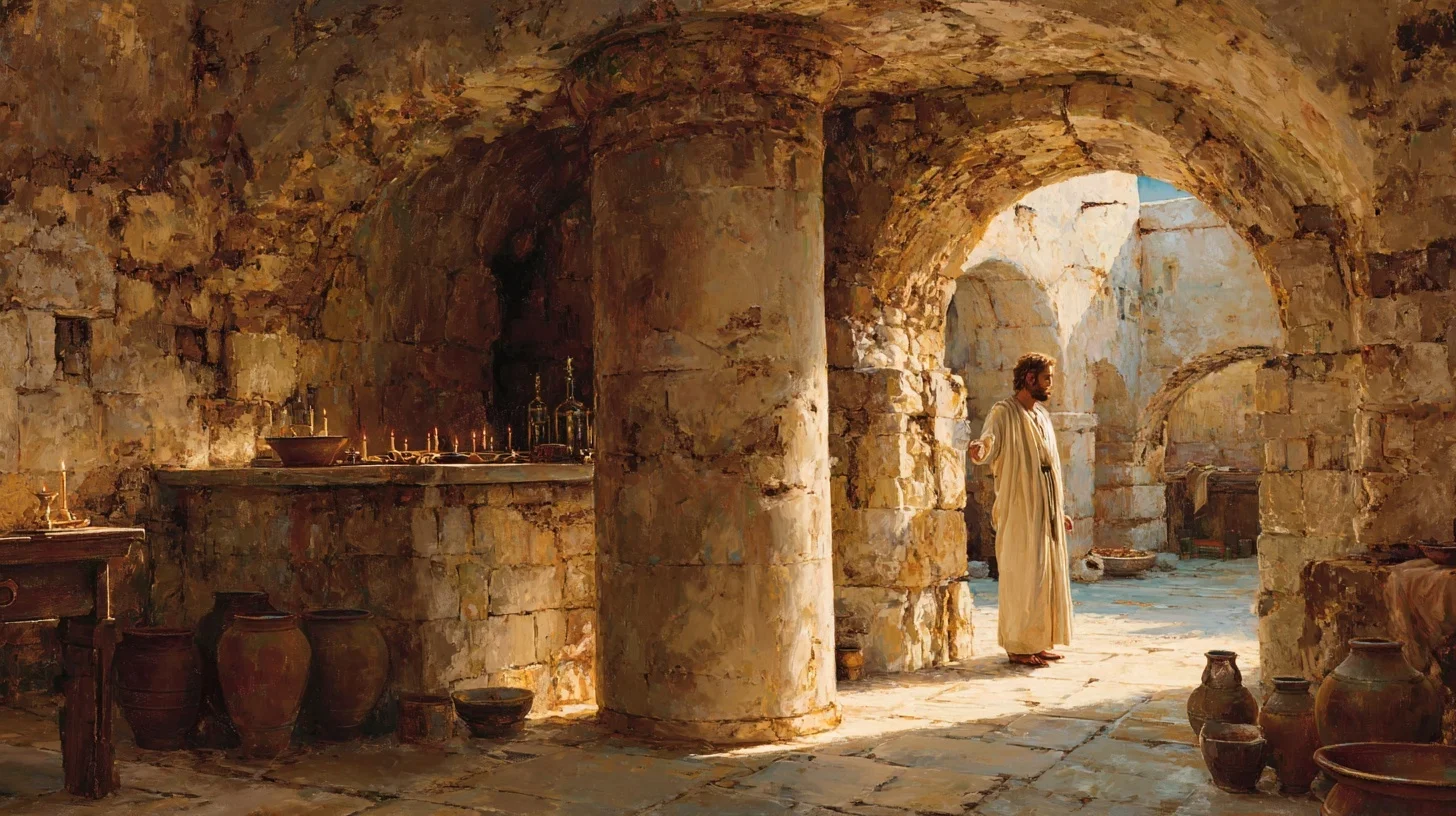
And finally, note how he makes an architectural analogy of the church: it is like a pillar and buttress of the truth. The irony of this analogy is that we work so hard to remind people that the church is NOT the building itself, rather it’s the people within it. Yet here Paul says in a way the church is like a critical part of a building. Like a pillar which “holds up” the building, the church has the responsibility to “hold up” the truth, or the gospel message from God’s Word. The church is not the source, or to continue the architectural analogy, the foundation, of the truth. But it has a special, divinely given role to uphold, protect, and thereby make available, the truth.
Paul ends this chapter with what is believed to be an excerpt of an early church hymn. It proclaims what he calls the “mystery of godliness.” Now, don’t mistake his use of the word “mystery” here. He doesn’t mean a mystery in the sense of something no one seems to understand. He means something that was hidden but now is revealed, just like a great mystery novel. What makes the mystery of the gospel so rich is that it was hidden from humanity for so long, but its revelation is so great that it was more than worth the wait!
The hymn itself is a beautiful, short summary of the gospel message:
God the Son was revealed to humanity as a man himself.
He was vindicated (that is, publicly proven and proclaimed innocent, in other words, Jesus was exactly who he said he was) by the Holy Spirit, in other words, God himself.
He was seen by angels means he was exalted before the heavenly realm, proving that he is in fact a divine being.
He was preached among the nations and believed on in the world refers to God’s redemptive plan being executed successfully before our very eyes.
He was taken up in glory refers both to the Ascension after his resurrection and to a foretaste of the ultimate exaltation of Christ after his return in the future.
All of us are witnesses to God’s glorious, merciful, redeeming message of abundant life and eternal salvation, and the degree to which people in this world will find that message credible and compelling is dependent on our character and behavior. We must guard our witness.
Discussion
- Paul calls the church a pillar that holds the truth up, not the foundation it rests on. Why does that distinction matter?
- “Mystery” here means hidden and now revealed, not unknowable. How does that change the way you hear the word in the New Testament?
- The hymn moves from flesh to glory in six lines. Which line is hardest for you to hold onto, and why that one?
- The chapter closes where it started, on character. Who is watching your life right now, and what are they learning about the gospel from it?
Frequently Asked Questions
What does “overseer” mean in 1 Timothy 3?
The Greek word is episkopos, meaning one who watches over or supervises. In the New Testament, the terms overseer, elder (presbyteros), shepherd, and pastor are often used interchangeably. Acts 20 shows Paul addressing the same group of leaders as elders in one verse and overseers in another, assigning them the task of shepherding.
What is the difference between an overseer and a deacon in the Bible?
Both are leadership roles in the church. Overseers focus on teaching, protecting, and shepherding the congregation. Deacons (from the Greek diakonos, meaning servant) focus on humble service to meet the practical needs of the church and its people. Both roles require godly character, but only overseers are required to be able to teach.
What does “husband of one wife” mean in 1 Timothy 3?
The literal Greek is “one woman man.” This phrase describes a man characterized by faithfulness and devotion to his wife. It speaks to the quality of character and commitment, not merely marital status. It is one item in a larger list of traits that together describe a person whose faith has visibly shaped their behavior.
Does 1 Timothy 3 allow women to serve as deacons?
Verse 11 is debated because the Greek word gyne can mean either “woman” or “wife.” Some read it as Paul addressing the wives of male deacons. Others read it as a reference to women deacons, or deaconesses. Romans 16:1-2, where Paul commends Phoebe as a servant (deaconess) of the church at Cenchreae, supports the view that women served in this role.
What is the “mystery of godliness” in 1 Timothy 3:16?
Paul uses the word “mystery” not to mean something unknowable, but something that was hidden and is now revealed. He then quotes what scholars believe was an early church hymn summarizing the gospel: Christ was manifested in the flesh, vindicated by the Spirit, seen by angels, proclaimed among the nations, believed on in the world, and taken up in glory.
Why does Paul call the church a “pillar and buttress of the truth”?
Paul uses an architectural analogy. A pillar holds up a building. The church holds up the truth by upholding, protecting, and making the gospel available to the world. The church is not the source or foundation of truth, but it has a divinely given role to support and proclaim it.
This lesson is part of the Guarding What Matters series.
Scripture quotations are from the ESV Bible (The Holy Bible, English Standard Version), copyright 2001 by Crossway.